



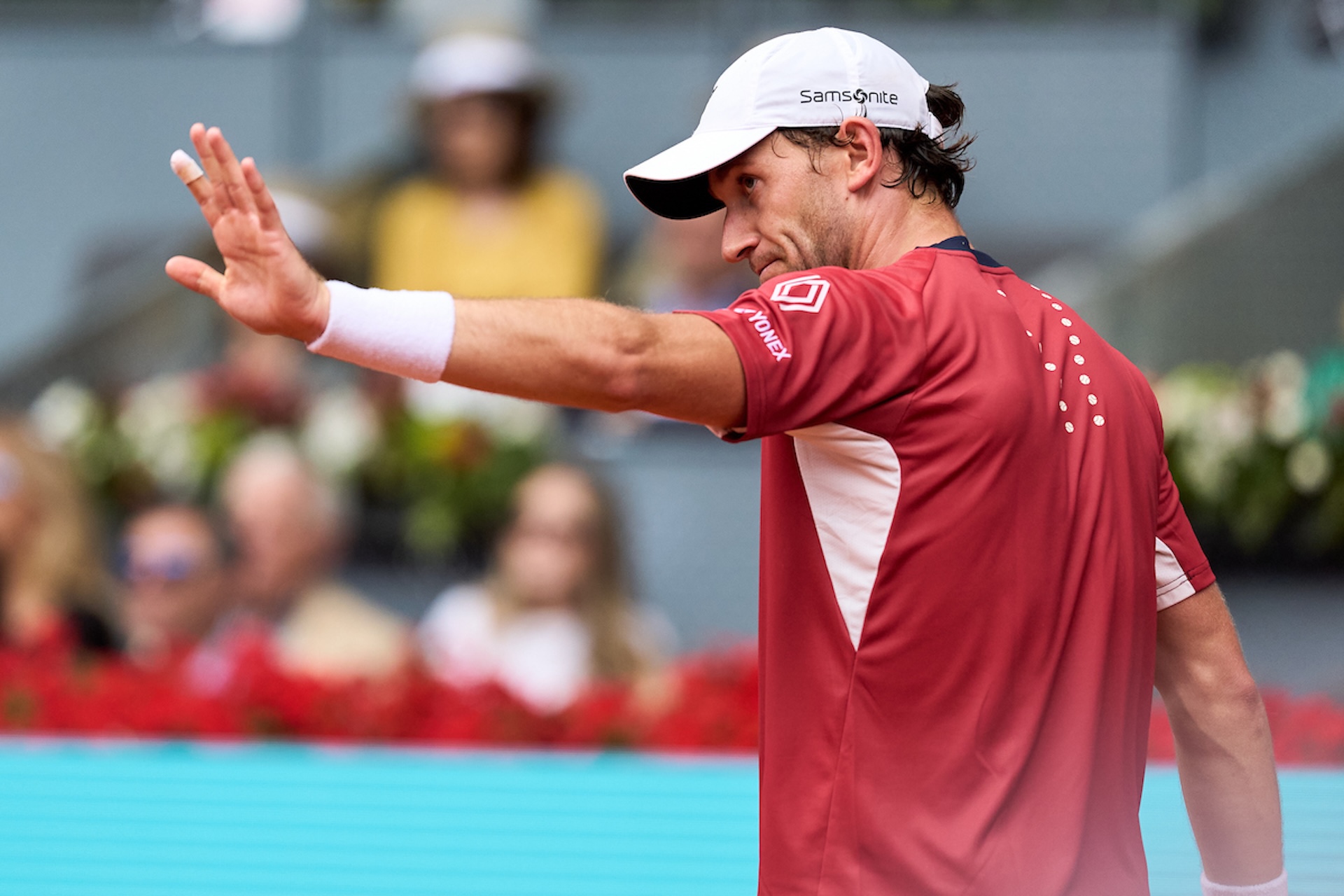
The curse has struck again in Madrid. Casper Ruud has failed in his task of defending the title he won last year, and the Mutua Madrid Open will once again crown a new champion. It’s no coincidence; it’s practically an unwritten rule in the Caja Magica. In the men’s draw, only Rafa Nadal and Carlos Alcaraz have managed to lift the trophy two years on the trot. In the women’s event, it’s a similar story; Simona Halep was the last to retain her crown, back in 2017, and before her, only Serena Williams had achieved that feat. Four names. And what names they are. In the ATP category only Spanish players have won back-to-back titles. To defend in Madrid, you have to do more than just play well, you must also survive a tournament that is a little different to the rest.
The question is obvious: why is it so difficult? The first answer lies in the overall level of the tour. Nowadays, any player can cause problems for any other. The most recent example came on Thursday, when Alexander Blockx dispatched Madrid’s reigning champion Ruud with authority, quite remarkable for someone still looking for his place among the elite. The Belgian, ranked 69th in the world, has reached his first ever Masters 1000 semi-final after defeating the Norwegian 6-4, 6-4, with an aggressive and direct brand of tennis that has adapted well to the courts of Madrid.
Nevertheless, there’s more to it. Madrid is clay, but it’s not the clay of Monte Carlo or Rome. The altitude of the capital, sitting at roughly 650 metres above sea level, changes the nature of the game. The ball travels faster, bounces higher, and gives a greater advantage to players who can serve hard, strike first, and shorten points. Because of these effects, Madrid offers the fastest clay conditions on tour.
Ruud himself provided a succinct explanation of the phenomenon: “The conditions in Madrid open up opportunities for other players. If you face someone with a great serve, or who can hit hard from the baseline, they can overwhelm you. In a different way than what would happen at a tournament at sea level”, said the Norwegian. It makes sense. In Madrid, the pure clay specialist doesn’t always find the comfort they enjoy at other venues. Here, the ball can come at you much faster.
And it’s not just Ruud saying so. Alexander Bublik also summed it up well: Madrid is “much faster than the other clay Masters 1000s”. Francisco Cerúndolo acknowledged that it’s “super fast here” too, and that the conditions favour the big servers. It’s no coincidence that in recent years players like Rublev, Zverev, Berrettini, Struff, Auger-Aliassime, and Draper – all capable of destroying the ball and punishing any short shots – have stood out.
Madrid is clay, but not as we know it, and retaining the title here is a huge ask because it’s not just about defending your crown; you have to defend it in a venue where there is far more room for upsets.
